
Where available, Open Access and Fulltext Links are indicated in bold font below. Please email me if you cannot access articles via the links below and would like a copy.
Secrecy, Transparency & Conspiracy
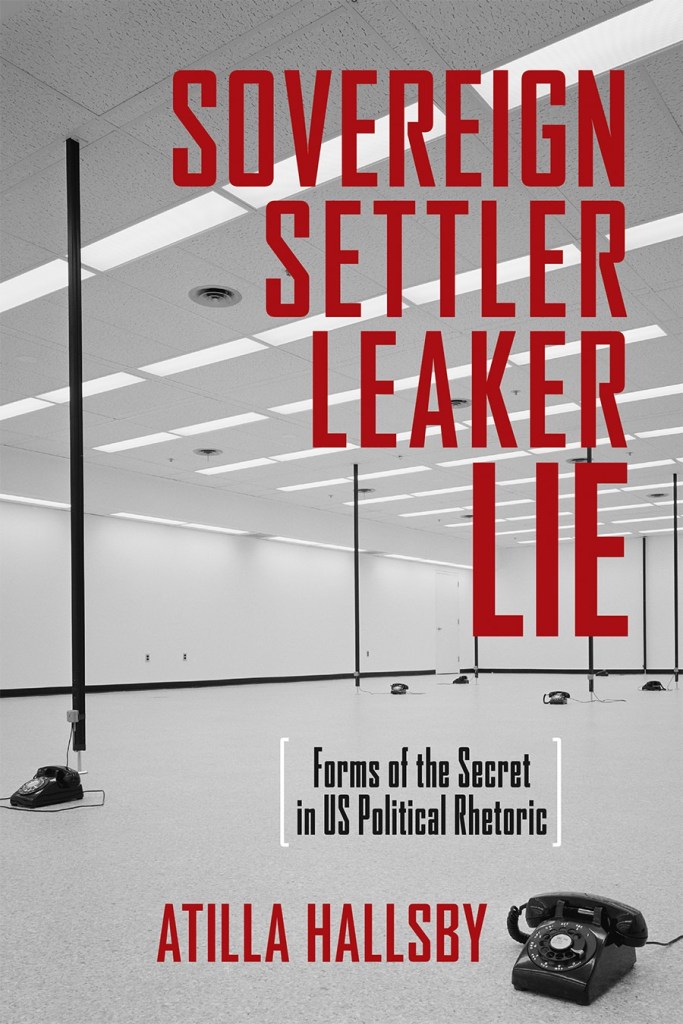
Monograph. Sovereign, Settler, Leaker, Lie: Forms of the Secret in U.S Political Rhetoric, (Columbus: The University of Ohio Press, 2026). See the book announcement here. This book will be released as an open-access title.
In Sovereign, Settler, Leaker, Lie, Atilla Hallsby argues that secrets play a pivotal role in organizing political discourse in the United States. Hallsby takes up contemporary case studies—ranging from the Valerie Plame scandal during the George W. Bush presidency, to the use of Saul Alinsky’s name as a partisan codeword for politicizing Obama’s Blackness, to Chelsea Manning’s public naming and outing—to show how dramatic revelations increasingly fail to produce meaningful change and instead reproduce entrenched racial, gendered, and colonial hierarchies.
The core feature of these interlinked moments of crisis is the secret: a rhetorical patterning of political life organized by specific forms, each one lending a familiar shape to the shadows of American empire. These forms, theorized here as tropes, connect decades of secrets, linking the George W. Bush administration’s War on Terror to the Trump-era reemergence of “deep state” conspiracy theories. As an extension of secrecy and surveillance studies, and with the aim of attaining a more accountable and just form of US governmentality, Sovereign, Settler, Leaker, Lie explains how still-unfolding political realities in the United States emerged, transformed, and regenerate.

Open Access Article. “Re-canonizing Rhetoric: The Secret in and of Discourse.” Journal for the History of Rhetoric volume 25, issue (2022): 346-70. https://doi.org/10.5325/jhistrhetoric.25.3.0346
Challenges to rhetoric’s canon often occur under the rubric of revising that canon and its foundational, shared meaning. Read through the strategies of deconstruction, the secret offers a common ground for recanonizing approaches by centering either a concealed quantity in ancient rhetoric’s granular archive (the secret in discourse) or an unfolding idea whose transformation has rendered it unrecognizable to its original version (the secret of discourse). This article draws on Jacques Derrida’s “White Mythology” (1974) and A Taste for the Secret (2001) before addressing how the secret’s registers in and of discourse animate de- and recanonizing readings of ancient Greek and Roman rhetoric. Its implications address scholars distressed by the durable forms of oppression ensconced in rhetoric’s ancient canon.

Article. with Dustin A. Greenwalt. “Graphed into the Conversation: Conspiracy, Controversy, and Climategate’s Visual Style.” Rhetoric Society Quarterly issue 51 volume 4 (2021): 293-308. https://doi.org/10.1080/02773945.2021.1947515
This essay reads the 2009 Climategate blogosphere through the rubric of visual style. We argue that Climategate bloggers used the stolen e-mails between prominent climate scientists to leverage claims about the proper perspective for seeing data, imitate institutional forms of climatological inquiry, and posit transparency as a moral imperative in many online forums. Rather than attacking science tout court, these appeals to visibility operated on the grounds of visuality and proof established by institutional forms of scientific inquiry, thus alleging climate change-denying bloggers were the “actual” scientists. By forwarding alternative visualizations of global temperature data and characterizing institutional climatology as secretive, Climategate bloggers significantly shaped public understandings of global warming. Ultimately, our purpose is to show how a visual style is an ambivalent form of rhetoric that scientific experts may also deploy in public science communication.

Article. “Psychoanalysis against WikiLeaks: Resisting the Demand for Transparency,” Review of Communication volume 20, issue 1 (2020): 69-86. https://doi.org/10.1080/15358593.2019.1706761
With the intensifying demand for transparency in government has come a dramatic increase in the number of spectacular public leaks that carry dramatic public consequences. This essay reviews how transparency has been considered an ideal of democratic theory and critical media scholarship and offers several psychoanalytic tenets for reading public demands for transparency. The essay then analyses discourse by and about WikiLeaks to illustrate how Julian Assange’s discourse results in a program of transparency that engages in destructive rituals of disavowal and exposure.

Article. “Imagine There’s No President: The Rhetorical Secret and the Exposure of Valerie Plame,” Quarterly Journal of Speech volume 101, issue 2 (2015), 354-378. https://doi.org/10.1080/00335630.2015.1024276
Covering a wide range of public discourse from 2003 to 2010 about CIA agent Valerie Plame, this essay contributes a novel rhetorical theory of secrets. By contrast to other critiques of the Bush-era secrecy that focus on policies the administration kept concealed from the public, I suggest that rhetoric is the means by which subjects figure the secret, to be understood as knowledge in the fact that the subject cannot know. To make this argument, I draw on the theoretical tools of psychoanalysis and the rhetorical tropes of repetition, caesura, and synecdoche.
Algorithms & artificial intelligence (a.i.)

Open Access Article. with Dan Faltesek. “Reconstructing Kairos and Chronos Across Trump’s Twitter/X Corpus: Computational Methods + Rhetorical Critique,” Western Journal of Communication volume 89, issue 2 (2025): 298-325. https://doi.org/10.1080/10570314.2024.2396506
The collective force of ex-U.S. President Donald Trump’s tweets/Xs is palpable in American public culture, political discourse, and academic rhetorical criticism. Adopting a critical and computational approach, this essay offers a novel method for the rhetorical analysis of social media-based public address by shifting emphasis from memorable exemplars of Trump’s social media discourse to the flow dynamics among those tweets/Xs. Focused on loops of tweets as recursive argument systems, we use a Latent Dirichlet Allocation (LDA) Markov Chain analysis to offer insight into the kairotic and chronic patterning of Trump’s social media utterances to map more and less stable argument strategies across distinct periods of his first Twitter/X presidency.

Open Access Article. “A Copious Void: Rhetoric as Artificial Intelligence Version 1.0,” Rhetoric Society Quarterly (2024). https://doi.org/10.1080/02773945.2024.2343265. Winner of the 2025 Golden Anniversary Monograph Award, National Communication Association.
Rhetoric is a trace retained in and by artificial intelligence (AI) technologies. This concept illuminates how rhetoric and AI have faced issues related to information abundance, entrenched social inequalities, discriminatory biases, and the reproduction of repressive ideologies. Drawing on their shared root terminology (stochastic/artifice), common logic (zero-agency), and similar forms of organization (trope+algorithm), this essay urges readers to consider the etymological, ontological, and formal dimensions of rhetoric as inherent features of contemporary AI.

Open Access Article. “The Rhetorical Algorithm: WikiLeaks and the Elliptical Secrets of Donald J. Trump,” Secrecy and Society issue 1, volume 12 (2018): 1-40. https://doi.org/10.31979/2377-6188.2018.010202.
Algorithms were a generative force behind many of the leaks and secrets that dominated the 2016 election season. Taking the form of the identity-anonymizing Tor software that protected the identity of leakers, mathematical protocols occupied a prominent place in the secrets generated during the presidential campaign. This essay suggests that the rhetorical trope of ellipsis offers an equally crucial, algorithmic formula for explaining the public production of these secrets and leaks. It then describes the 2016 DNC leak and Donald Trump’s “I love Wikileaks” moment using the trope of ellipsis, which marks a discursive omission or gap in official executive discourse.
Rhetorical Theory
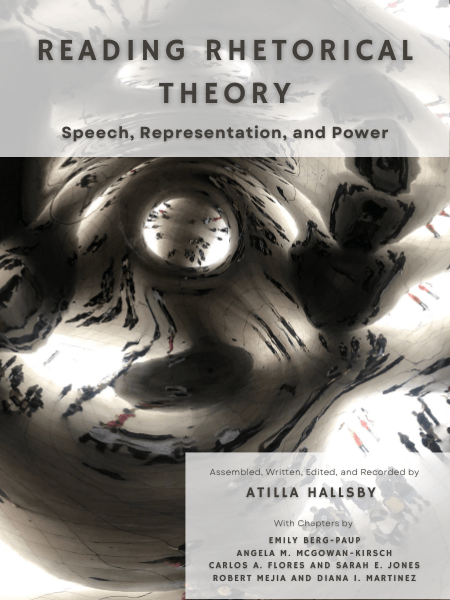
Open Access Textbook. Author and Editor. with Emily Berg Paup, Carlos A. Flores, Sarah E. Jones, Diana I. Martínez, Angela M. McGowan-Kirsch, and Robert Mejia. Reading Rhetorical Theory: Speech, Representation, and Power. Minneapolis: University of Minnesota Libraries, 2022. ISBN: 978-1-946135-88-9.
This textbook offers an undergraduate-appropriate survey of rhetorical theory centered on techniques of speaking, cultural modes of representation, and entrenched hierarchies of power. It covers rhetoric’s problematic “origins” in ancient Greece, rhetoric as a feature of 20th-century sign- and symbol-systems, rhetoric’s role in crafting shared ideologies and belief systems, narrative-, argument-, and visual-based approaches to rhetoric, and a variety of different “situations” (rhetorical, settler colonial, secrecy/surveillance, and digital) where rhetoric continues to be found and felt in contemporary U.S. culture. This book also includes audio or video recordings for each chapter, and recommended written assignments. Developed in the wake of the 2020 global pandemic, this resource is designed for a range of modalities (online synchronous, online asynchronous, in-person, and hybrid). Additional materials (PowerPoint slides, quiz/exam questions) are also available to confirmed instructors upon request.

Article. “What is Rhetoric Enough? Forms in and of Rhetoric Scholarship.” Journal for the History of Rhetoric issue 28, volume 1 (2025): 71-96. DOI: 10.5325/jhistrhetoric.28.1.0071.
This article poses the question, What is rhetoric enough? as a provocation about the hurdles emerging scholars must traverse. The first is fear that their scholarship is not “enough” to meet the topical, theoretical, and evidentiary standards of rhetoric studies, while the second is the criticism that there is “too much” rhetoric in communication scholarship. Together, these create a wicked polarity. This article answers this question by drawing on the strategy of prepositional criticism, which posits “both/and” answers as affirmative rejoinders to “either/or” framings of rhetoric’s grounding in either tradition or transformation. To that end, it offers five provisions that elaborate distinct forms in and of rhetoric scholarship: (1) rhetoric can be understood as a contained feature in and productive effect of discourse; (2) exigencies define the context in and purpose of scholarship; (3) theory is embedded in and an enactment of rhetorical criticism; (4) community is invoked in and a creation of academic discourse; and (5) citation can be thought of as a way to document scholars’ due diligence in their writing and as an active habit or practice of constituting a conversation.
Psychoanalytic Theory
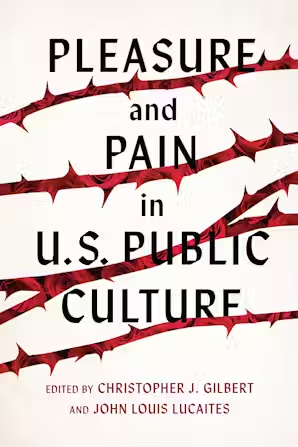
Book Chapter. with Joshua Gunn. “Pleasure, Pain, and the Mirror of Enjoyment,” in Pleasure and Pain in U.S. Public Culture (Tuscaloosa: U. Alabama Press, 2024), 140-63. Fulltext Linked Above.
Atilla Hallsby and Joshua Gunn draw on Lacanian psychology, developing the concept of “the mirror of enjoyment” as a rhetorical logic and mode of identification that underwrites the political polarization that makes it impossible to achieve bipartisanship, particularly in the face of potentially apocalyptic events such as the advent of a pandemic. Drawing upon early reactions to the appearance of COVID-19, they identify two such logics, which they name as mirroring “sadistic pleasure” and “enjoyment’s zero-sum game.” To illustrate sadistic pleasure, they turn to the refusal of police officers to be vaccinated and then taking pleasure in projecting their pain and suffering – animated not just from their loss of jobs, but also from contracting and dying from COVID-19 – back upon those whom they presumed to relish it, that is, liberals, who now become the scapegoats for their original decision not to vaccinate. Enjoyment’s zero-sum game gets played out in ways that conspiracy theorists of the right like radio personality Alex Jones mirror the liberal cynicism of someone and thus reinforcing polarized political subjectivities. Hallsby and Gunn conclude with a provocative reflection on the implications for such an analysis on the future of the possibilities for negotiating conflicts between liberalism and illiberalism, both its pleasures and its pains.

Article. “Intimate Spaces of Mental Wellness.” Rhetoric, Politics, & Culture issue 1, volume 1 (2021): 55-66. ISSN: 2693-7549. Fulltext Linked Above.
This forum piece offers the concept of intimate spaces of mental wellness as an alternative to top-down psychoanalytic theorizing, starting from ground- up communities of practice that cultivate knowledge and shared vulnerability to relieve anguish. It proposes a de-linking of psychoanalytic theory rooted in the belief that psychoanalysis is still a helpful theory-of-practice and that shared spaces of truth-telling and intimacy are essential to cultivating community and healthy attachments. Transformed, psychoanalysis—or better, psychoanalyses—forecast how popular and poststructural theories of rhetoric might yet be de-linked from their repressive epistemic foundations.

Encyclopedia Entry. “Psychoanalytic Methods and Critical Cultural Studies.” [Pre-Publication Draft of Entry], Oxford Research Encyclopedia, 2019. Fulltext Linked Above.
Within Communication Studies, critical and cultural scholars will likely encounter
psychoanalytic methods by way of Rhetoric scholarship, which has made plentiful and recurring use of Freudian and Lacanian concepts. This entry offers a survey of psychoanalytic methods ‘before’ and ‘after’ the linguistic turn, juxtaposing key concepts with rhetorical scholarship that employs it.
Psychoanalytic theory is foundationally the study of the unconscious. Before the linguistic turn, the Freudian theory of the unconscious informed Kenneth Burke’s theory of identification developed in A Rhetoric of Motives and numerous Jungian analyses of cinematic texts. In the linguistic turn’s aftermath, the psychoanalytic theory of Jacques Lacan contributed understandings of speech, identification, and rhetoric that transformed Freud’s original formulations. These contributions, captured in Lacan’s four fundamental concepts of psychoanalysis, registers of the unconscious, and “Seminar on ‘The Purloined Letter’,” illustrate a variety of ways that critical and cultural scholars have enlisted psychoanalysis to describe instances of public address, social movements, political and legal discourse, and cinema/film.
The unique feature of Lacan’s approach is that the unconscious is structured like a language, which means that the unconscious is received as a speech act. Moreover, contrary to the view that the subject uses the signifier, Lacan maintains that the signifier exercises an organizing role over the subject and its desire. Conceived within the history, theory, and practice of Rhetoric, psychoanalytic theory offers conceptually rich insights tethered to the concepts of the unconscious, the signifier, and the drive (among others) that are enabling to the aims of critical and cultural studies.
Book Reviews

Book Review. Crisis Vision: Race and the Culture of Surveillance by Torin Monahan in Cultural Studies issue 38, volume 4 (2024): 972-975. https://doi.org/10.1080/09502386.2024.2383210

Book Review. Awful Archives: Rhetoric, Conspiracy, and Acts of Evidence by Jenny Rice in Rhetoric Society Quarterly issue 52 volume 2 (2022). https://doi.org/10.1080/02773945.2022.2059332
Presentations
Panelist. Response to Caddie Alford’s Entitled Opinions: Doxa after Digitality. National Communication Association Conference, New Orleans, LA. November 20-24, 2024.
Respondent. Response to Playing With Fire: African American Rhetoric from Turner to Obama, National Communication Association Conference, SLC, UT. November 8, 2018.
Panelist. Response to Grano’s The Eternal Present of Sport. Southern States Communication Association, Nashville, TN. April 4-8, 2018.
Panelist. Response to The Rhetorical Invention of America’s (In)Security State. National Communication Association, Dallas, TX. November 16, 2017.
 Atilla Hallsby