“A Copious Void” Recieves Golden Anniversary Monograph Award from the National Communication Association

Convention logo for the 2025 National Communication Association Convention, which includes an image of clouds and bubbles assembled into the shape of a hot air balloon. The name of the convention theme is also included: "Communicate to Elevate."

I’m honored to have received the National Communication Association’s Golden Anniversary Monograph Award for my essay, “A Copious Void: Rhetoric as Artificial Intelligence 1.0”!
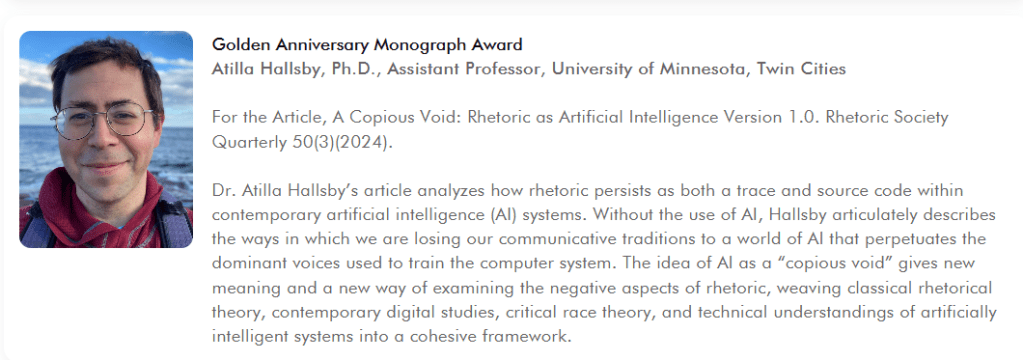
I’m floored in particular that folks have found the essay to be useful as ai development has intensified in dire, dangerous, and ever more death-centred ways since 2024. I’m so grateful to S. Scott Graham and Zoltan Majdik for their support for this piece and their willingness to include it in their special issue. I am also indebted to Joshua Trey Barnett’s editorial guidance. Truly, this essay would not have turned out as it did had it not been for them and the anonymous reviewers, all of whom made the product immeasurably better.

To that end, please check out the entire “Rhetoric of/with AI” special issue. It is excellent and deserves your attention if you are engaged with this particular topic. There is an amazing introduction from S. Scott Graham & Zoltan Majdik, incredible work on reproductive surveillance from Kem-Laurin L. & Randy Allen Harris, incisive, care-driven criticism on ai as a form of time-traveling memory from Emma Bedor Hiland, genre-based methods from Ryan Omizo & Bill Hart-Davidson, timely reflections on #WallStreetBets from Misti Yang & Zoltan Majdik, and a spicy conclusion from Casey Boyle. Please check it out!

New Open-Access Publication: “Reconstructing Kairos and Chronos Across Trump’s Twitter/X Corpus: Computational Methods + Rhetorical Critique” in the Western Journal of Communication

Recently published in the Western Journal of Communication, this OA publication co-authored with Dan Faltesek of Oregon State University offers a hybrid computational-rhetorical take on Trump’s first term. It employs a MALLET (machine learning) topic model to periodize his (almost) full Twitter corpus (c. 2010-2020).

Our key finding is that in different periods of his twitter life distinct patterns can be identified in the post-to-post flow of Trump Twitter, and that these arguments are substantially more coherent and important than any particular tweet.

You can find the full abstract below the link

https://www.tandfonline.com/doi/full/10.1080/10570314.2024.2396506

Abstract: The collective force of ex-U.S. President Donald Trump’s tweets/Xs is palpable in American public culture, political discourse, and academic rhetorical criticism. Adopting a critical and computational approach, this essay offers a novel method for the rhetorical analysis of social media-based public address by shifting emphasis from memorable exemplars of Trump’s social media discourse to the flow dynamics between those tweets/Xs. Focused on loops of Tweets as recursive argument systems, we use a Latent Dirichlet Allocation (LDA) Markov Chain analysis to offer insight into the kairotic and chronic patterning of Trump’s social media utterances to map more and less stable argument strategies across distinct periods of his first Twitter/X presidency.

DRPC Privacy Week Presentation: “We Live In Public”

On January 22, 2024, the Digital Rhetoric and Privacy Collective hosted an online session titled “Teaching About Privacy in an Age of Generative AI“ with Drs. Calvin Pollak of the University of Washington (who presented “Navigating Publicity and Privacy: Genre-Based Technical Communication Pedagogy With, For, and Against ChatGPT”) and Reed Hepler, a Digital Initiatives Librarian and Archivist at College of Southern Idaho (who presented “Deliberately Safeguarding Privacy and Confidentiality in the Era of Generative AI”) and myself. The title of my presentation was “We Live in Public: Teaching Publicity, Privacy, and Secrecy.” Links to both the DRPC and a video of the presentation(s) can be found below.