
You can access a recording of the book event from 3/18 HERE.
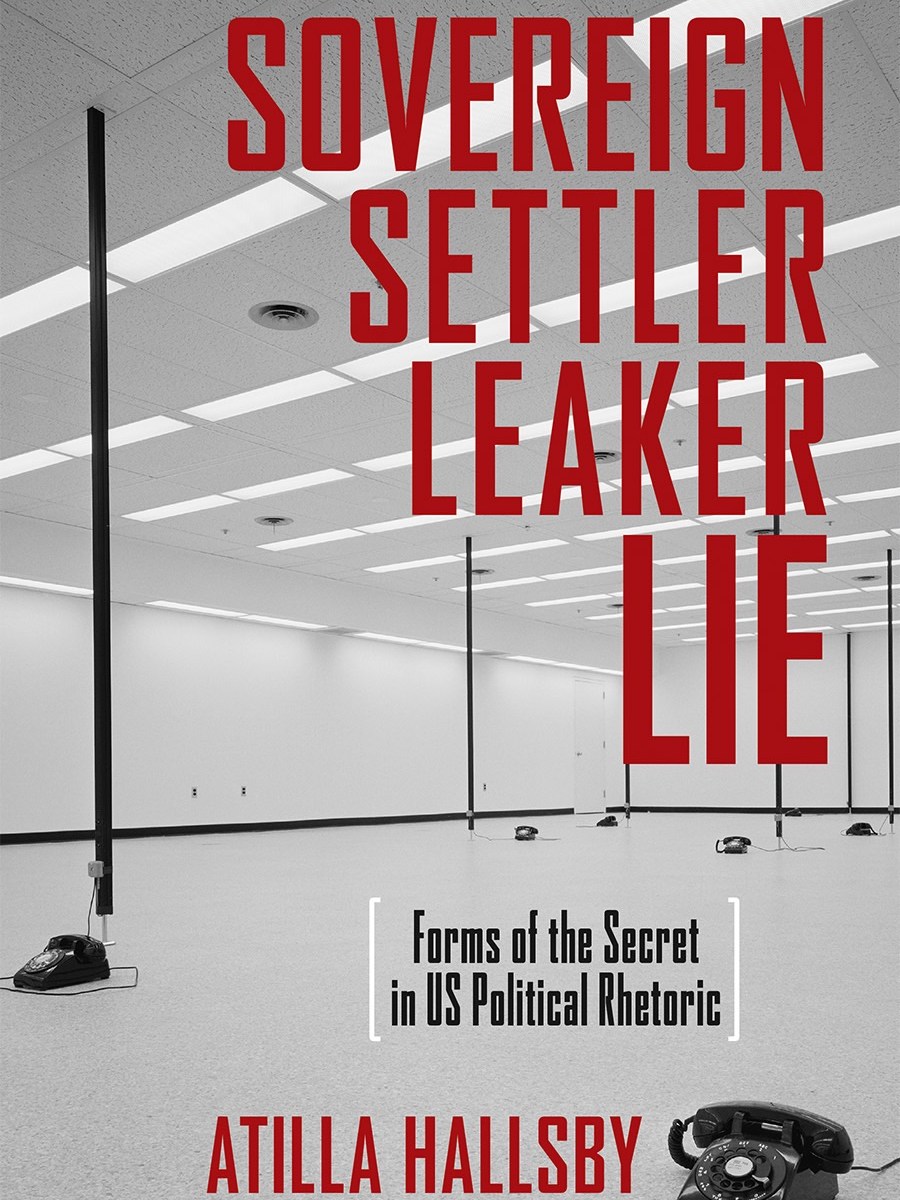
I’m thrilled to announce that Sovereign, Settler, Leaker, Lie: Forms of the Secret in U.S. Political Rhetoric, was published with Ohio State University Press earlier this month!
If you are interested in purchasing a copy, please use the code HALLSBY at www.ohiostatepress.org to receive 30% off of the paperback version. This book will be freely available in an open access edition thanks to TOME (Toward an Open Monograph Ecosystem)—a collaboration of the Association of American Universities, the Association of University Presses, and the Association of Research Libraries—and the generous support of the University of Minnesota Libraries. Learn more at the TOME website, available at openmonographs.org. An open access copy of the monograph is also currently available to view at The Ohio State University’s Knowledge Bank repository.
Book Release Event. There will also be a online-accessible book release event on Wed, Mar 18, 2026 from 4 – 5:30 PM hosted by the Department of Race, Indigeneity, Disability, Gender, and Sexuality Studies (RIDGS) at the University of Minnesota. There will be a book raffle and the event will be hosted by Kyra Bowar (Communication Studies at the University of Minnesota) with responses from Dr. Ira Allen (University of Northern Arizona) and Dr. Palita Chunsaengchan (University of Minnesota, Twin Cities). Please follow this link to register for this event!
About this book. In Sovereign, Settler, Leaker, Lie: Forms of the Secret in US Political Rhetoric, Atilla Hallsby argues that secrets play a pivotal role in organizing political discourse in the United States. Hallsby takes up contemporary case studies—ranging from the Valerie Plame scandal during the George W. Bush presidency, to the use of Saul Alinsky’s name as a partisan codeword for politicizing Obama’s Blackness, to Chelsea Manning’s public naming and outing—to show how dramatic revelations increasingly fail to produce meaningful change and instead reproduce entrenched racial, gendered, and colonial hierarchies.
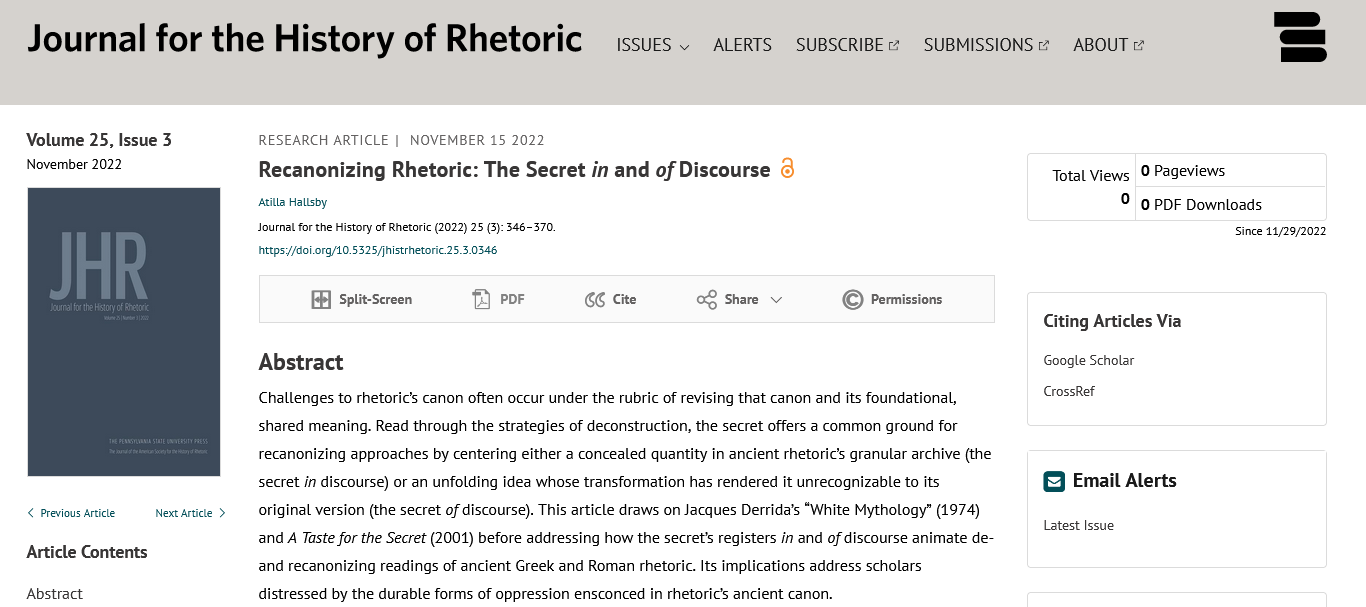
Sovereign, Settler, Leaker, Lie tells two stories. The first concerns the epistemic, historical, and rhetorical precedents for the secret’s prolonged crises. This story is laid out in chapters 1–2, which address the secret as an object and as a method, respectively. Chapter 1 (“The Secret Episteme”) recounts a genealogy of the secret, arguing for it as a form of knowledge whose primary conceit is the concealment of knowledge. Chapter 2 (“The Secret in and of Discourse”) furnishes the theoretical grounding for this book and introduces the phrasing “in and of discourse” to point to the secret’s divided structure.
The second story concerns the secret and its formal variations in the early twenty-first century and features the scandal, dog whistle, leaker, and detective. These chapters also pair a specific variation of the secret with a distinct hegemonic context. Beyond the implicit reference to John LeCarre’s famous spy novel, Tinker, Tailor, Soldier, Spy, these chapters also lend the book’s title its performative twist: The scandal centers sovereign power and white supremacy, the settler is associated with the detective, and highlights the pervasiveness of settler colonialism in popular and political culture, the leaker is associated with the national security state vulnerability, and features a national context of heterosexual and cisgender normativity, and the lie is associated with the dogwhistle, and foregrounds racism and anti-Blackness. Beginning with George W. Bush and ending with Joseph R. Biden, these chapters are semi-chronological and seek to reflect on the secret’s forms as precedent for Donald Trump’s first and second presidential administrations.
The core feature of these interlinked moments of crisis is the secret: a rhetorical patterning of political life organized by specific forms, each one lending a familiar shape to the shadows of American empire. These forms, theorized here as tropes, connect decades of secrets, linking the George W. Bush administration’s War on Terror to the Trump-era reemergence of “deep state” conspiracy theories. As an extension of secrecy and surveillance studies, and with the aim of attaining a more accountable and just form of US governmentality, Sovereign, Settler, Leaker, Lie explains how still-unfolding political realities in the United States emerged, transformed, and regenerate.
Praise for Sovereign, Settler, Leaker, Lie.
“Much work on the secret skirts over its rhetorical form and associated tropes, but Hallsby has written a rigorous, capacious, and highly engaging account that situates the secret historically and culturally. Essential reading for those interested in the politics and aesthetics of secrecy.” —Clare Birchall, author of Radical Secrecy: The Ends of Transparency in Datafied America
“Sovereign, Settler, Leaker, Lie generatively brings rhetorical studies into conversation with surveillance studies to offer important expansions and correctives to the study of secrecy. Drawing on a rich historical archive, Hallsby powerfully illustrates the secret’s material impacts and entanglements with racial, sexual, colonial, and gendered violences.”” —Mia Fischer, author of Terrorizing Gender: Transgender Visibility and the Surveillance Practices of the U.S. Security State
“Presented from a psychoanalytic perspective that refuses to collapse into binaries of suspicion and faith, Sovereign, Settler, Leaker, Lie is both reassuring for its ability to ‘name’ contemporary rhetorical dynamics and sobering because, as Freud once put it, we are not masters of our own house.” —Joshua Gunn, author of Political Perversion: Rhetorical Aberration in the Time of Trumpeteering
“Smart, playful, and theoretically sophisticated, Sovereign, Settler, Leaker, Lie introduces us to the hard truths of secrecy in American politics. A one-of-a-kind book.” —Joshua Reeves, coauthor of The Prison House of the Circuit: Politics of Control from Analog to Digital
“This analytically sophisticated book offers a captivating exploration of the often-destructive role of political secrets in society. Whether found in conspiracy theories, national security leaks, or fabrications supporting war, Atilla Hallsby shows how secrets powerfully shape collective knowledge and legitimize forms of violence.” —Torin Monahan, author of Crisis Vision: Race and the Cultural Production of Surveillance







 Atilla Hallsby