
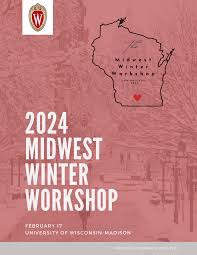
“What is Rhetoric Enough?” was initially presented as the keynote address for the 2024 Midwest Winter Workshop (MWW) hosted by the Department of Communication Arts at the University of Wisconsin-Madison. Although much remains the same, it has been edited from its original outline format for readability and to include citations that were not in the original due to time constraints.
ARTICLE @ Journal for the History of Rhetoric
PROOFS/Article Pre-Print (nearly identical to final version)
ABSTRACT: This article poses the question, What is rhetoric enough? as a provocation about the hurdles emerging scholars must traverse. The first is fear that their scholarship is not “enough” to meet the topical, theoretical, and evidentiary standards of rhetoric studies, while the second is the criticism that there is “too much” rhetoric in communication scholarship. Together, these create a wicked polarity. This article answers this question by drawing on the strategy of prepositional criticism, which posits “both/and” answers as affirmative rejoinders to “either/or” framings of rhetoric’s grounding in either tradition or transformation. To that end, it offers five provisions that elaborate distinct forms in and of rhetoric scholarship: (1) rhetoric can be understood as a contained feature in and productive effect of discourse; (2) exigencies define the context in and purpose of scholarship; (3) theory is embedded in and an enactment of rhetorical criticism; (4) community is invoked in and a creation of academic discourse; and (5) citation can be thought of as a way to document scholars’ due diligence in their writing and as an active habit or practice of constituting a conversation.
I am presently at work co-editing a forum with Ariel Seay- Howard of North Carolina State University, assembling a number of other contributors who also responded to this same prompt. The forum is based on a featured panel held at the National Communication Association (NCA) convention in 2024.
About this Essay
My intended audience was graduate students, and my objective was less to provide a comprehensive view of rhetorical studies and more to capture a snapshot of the field based on the community gathered for the 2024 MWW.
One feature that is less apparent in this version is that the many citations – especially those in second section – are drawn primarily from the published scholarship of MWW workshop leaders, many of whom were in the audience for this speech.
Acknowledgments
Thank you to Allyson Gross, Alicen Rushevics, Megan L. Zahay, and Ailea Merriam-Pigg for
their invitation to deliver this 2024 Midwest Winter Workshop (MWW) keynote address, aswell as to Rob Asen, Rob Howard, Jenell Johnson, and Allison Prasch, who are the most
generous interlocutors and incredible hosts.
At the MWW, Cara Finnegan, Rob Asen, and
Rachel Bloom-Pojar asked me important questions that have stuck with me as I edited this final version, and I am grateful to Emily Winderman for her suggestion to address each of the workshop’s faculty mentors. I’m also indebted to Ned O’Gorman for the opportunity to publish this keynote, the participants from the MWW whose encouragement nudged me
toward publishing this essay, and to Lauren Seitz for editorial guidance in bringing this to
print.
Finally, I wish to offer a special thanks to Ariel Seay-Howard, the “What is Rhetoric
Enough?” panelists at NCA 2024, and the Institute for Advanced Studies at the University of Minnesota, Twin Cities for their time, labor, and support for this project.
 Atilla Hallsby