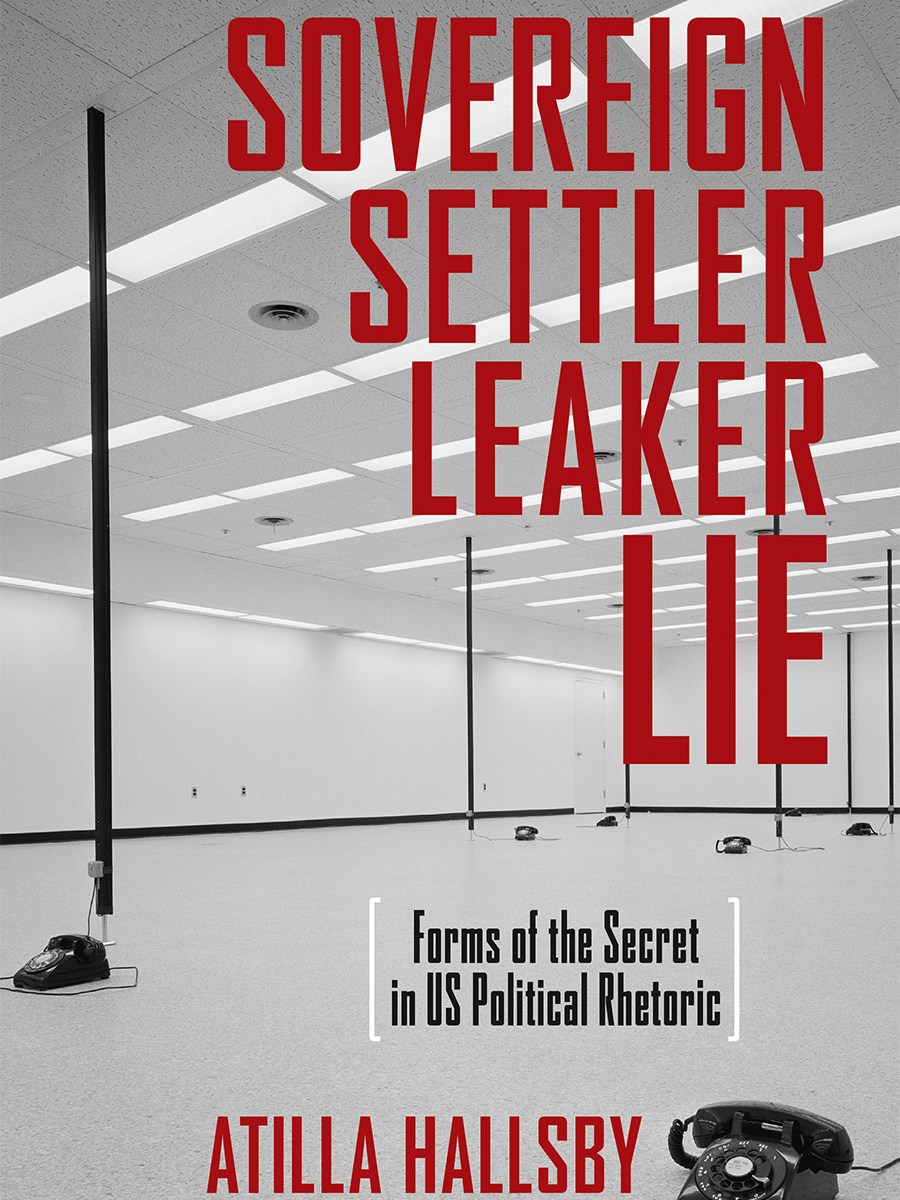
Coming Soon! Sovereign, Settler, Leaker Lie: Forms of the Secret in U.S. Political Rhetoric

To be published by The Ohio State University Press in February 2026

Pre-orders available at the link below. This book will also be released as an open-access title. If you are interested in a desk copy once it becomes available, please reach out! I am happy to respond to requests given availability/demand. Stay tuned and I hope you check it out!

https://ohiostatepress.org/books/titles/9780814216057.html

Book Jacket Description

In Sovereign, Settler, Leaker, Lie, Atilla Hallsby argues that secrets play a pivotal role in organizing political discourse in the United States. Hallsby takes up contemporary case studies—ranging from the Valerie Plame scandal during the George W. Bush presidency, to the use of Saul Alinsky’s name as a partisan codeword for politicizing Obama’s Blackness, to Chelsea Manning’s public naming and outing—to show how dramatic revelations increasingly fail to produce meaningful change and instead reproduce entrenched racial, gendered, and colonial hierarchies.

The core feature of these interlinked moments of crisis is the secret: a rhetorical patterning of political life organized by specific forms, each one lending a familiar shape to the shadows of American empire. These forms, theorized here as tropes, connect decades of secrets, linking the George W. Bush administration’s War on Terror to the Trump-era reemergence of “deep state” conspiracy theories. As an extension of secrecy and surveillance studies, and with the aim of attaining a more accountable and just form of US governmentality, Sovereign, Settler, Leaker, Lie explains how still-unfolding political realities in the United States emerged, transformed, and regenerate.

Reception

“Much work on the secret skirts over its rhetorical form and associated tropes, but Hallsby has written a rigorous, capacious, and highly engaging account that situates the secret historically and culturally. Essential reading for those interested in the politics and aesthetics of secrecy.” —Clare Birchall, author of Radical Secrecy: The Ends of Transparency in Datafied America

“Presented from a psychoanalytic perspective that refuses to collapse into binaries of suspicion and faith, Sovereign, Settler, Leaker, Lie is both reassuring for its ability to ‘name’ contemporary rhetorical dynamics and sobering because, as Freud once put it, we are not masters of our own house.” —Joshua Gunn, author of Political Perversion: Rhetorical Aberration in the Time of Trumpeteering

“Smart, playful, and theoretically sophisticated, Sovereign, Settler, Leaker, Lie introduces us to the hard truths of secrecy in American politics. A one-of-a-kind book.” —Joshua Reeves, coauthor of The Prison House of the Circuit: Politics of Control from Analog to Digital

Sovereign, Settler, Leaker, Lie generatively brings rhetorical studies into conversation with surveillance studies to offer important expansions and correctives to the study of secrecy. Drawing on a rich historical archive that includes figures like Alan Turing, Saul D. Alinsky, Valerie Plame Wilson, and Chelsea Manning, Hallsby powerfully illustrates how secrets are not just in but of discourse. In so doing, he importantly foregrounds the secret’s material impacts and entanglements with racial, sexual, colonial, and gendered violences.” —Mia Fischer, author of Terrorizing Gender: Transgender Visibility and the Surveillance Practices of the U.S. Security State

“This analytically sophisticated book offers a captivating exploration of the often-destructive role of political secrets in society. Whether found in conspiracy theories, national security leaks, or fabrications supporting war, Atilla Hallsby shows how secrets powerfully shape collective knowledge and legitimize forms of violence.” —Torin Monahan, author of Crisis Vision: Race and the Cultural Production of Surveillance

Open Access Textbook Updates in 2025

Some changes will be coming to the UnTextbook and Reading Rhetorical Theory in 2025!

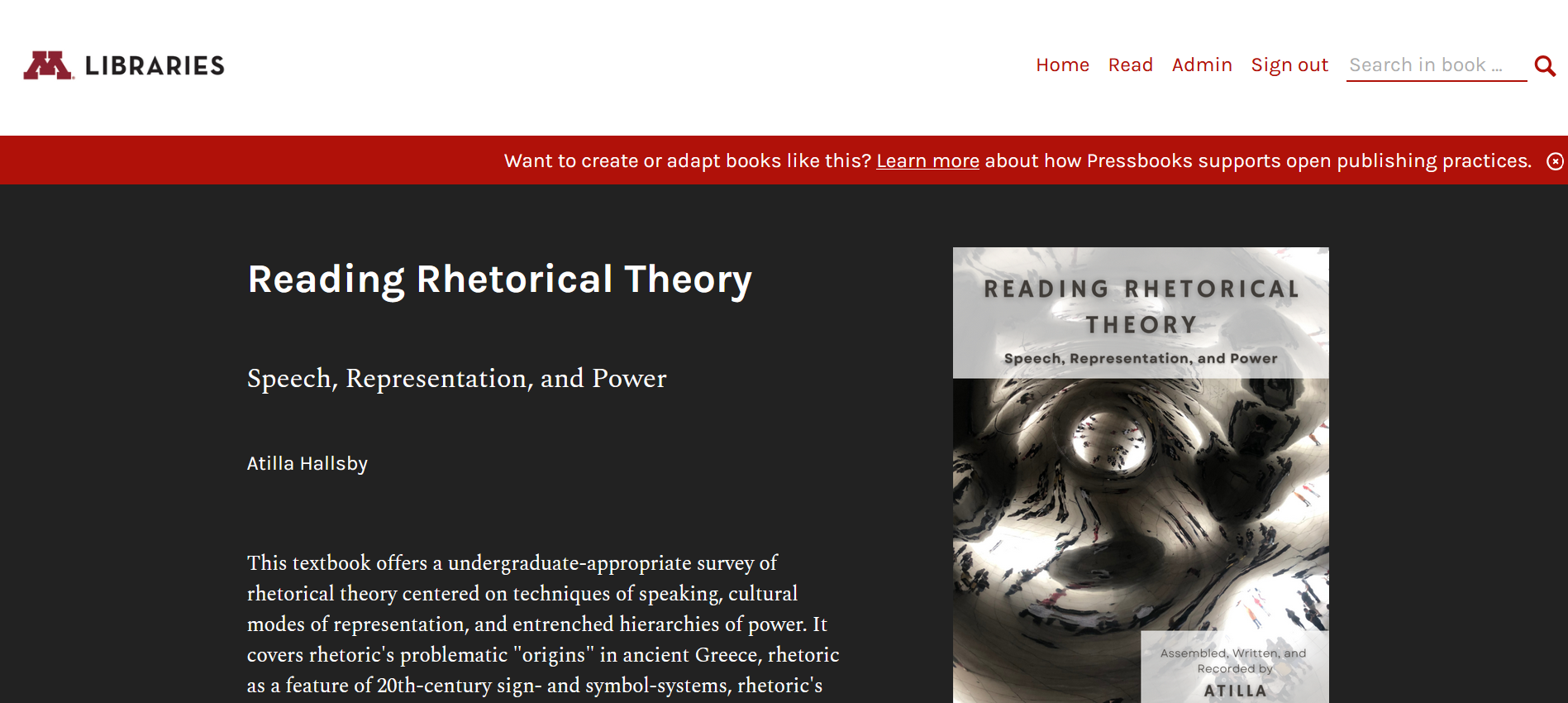
The main chapters of the UnTextbook were published as an online textbook with the University of Minnesota Libraries in 2022 (https://open.lib.umn.edu/rhetoricaltheory/). Publishing this as an online textbook gave this resource an ISBN and allowed it to circulate more widely in online libraries like the OER Commons. As of September 2024, Reading Rhetorical Theory: Speech, Representation, and Power (RRT) has been adopted by more than 60 universities and colleges. The upcoming changes have to do with modifications to Reading Rhetorical Theory and to the front-page design of this website.

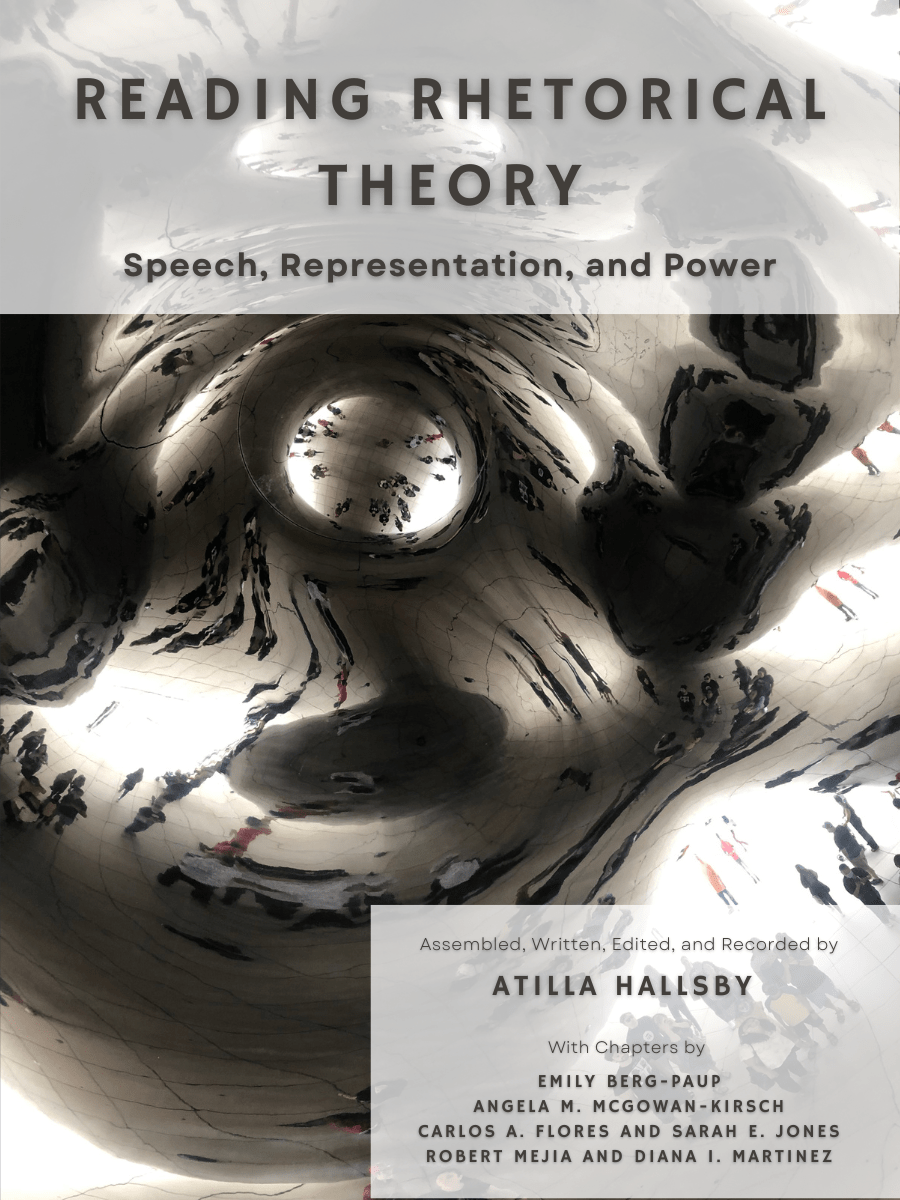
Reading Rhetorical Theory, the online textbook version of the UnTextbook of Rhetorical Theory. To view the book, go to https://open.lib.umn.edu/rhetoricaltheory

Find out more about RRT adoptions

If you have been using the UnTextbook or Reading Rhetorical Theory, I would love to have your feedback! I’m collecting testimonials from folks who have found these resources useful. I’ve set up this survey for folks, or you can send me a message at rhetoricaltheoryuntextbook-at-gmail-dot-com. Either would be greatly appreciated!

So, what’s changing?

Updates for Spring-Summer 2025

The UnTextbook is staying open, and you will still be able to access the course content posted there. By June-August 2025, however, some links may change, requiring updates to course syllabi before the Fall.

UPDATE #1: The UnTextbook of Rhetorical Theory

My plan is to replace the chapters on the main UnTextbook page with icons for the textbook and other course offerings:

  1. Reading Rhetorical Theory: Speech, Representation, and Power (this would direct you to the OER site).
  2. The (Undergraduate) UnTextbook Rhetorical Theory (you would be able to access the chapters currently posted on the main page).
  3. The (Graduate) UnTextbook of Rhetorical Theory.
  4. The Rhetoric of Secrecy and Surveillance.

UPDATE #2: Reading Rhetorical Theory

All Updates and Changes to RRT

The largest change to RRT is four new chapters from invited authors to Reading Rhetorical Theory in Spring 2025. This has required reorganizing the chapter order of that book. The new chapters include:

  • “The Public Sphere” by Angela McGowan Kirsch
  • “Counterpublics” by Carlos A. Flores and Sarah E. Jones
  • “Latine Rhetorical Theory” by Robert Mejia and Diana I. Martinez
  • “Rhetoric and the First Amendment” by Emily Berg Paup

Some things to note:

(1) the new chapters will not appear on the UnTextbook site.

(2) Although the order of the chapters is slightly changed as compared to what appears on this site, the content is identical (save for some new images).

(3) As always, there is no chapter 13.

(4) The links to “The Public Sphere” and “Counterpublics” will be ready in January 2025; the links to “Latinx Rhetoric(s)” and “Rhetoric and the First Amendment” will go live later.

(5) Finally, if you are considering switching from the UnTextbook to Reading Rhetorical Theory, know that the latter is more recently updated and has been copy-edited, meaning the content you’ll find there is likely more grammatically correct and up-to-date.

You can find updated links for the textbook below if you are looking to adjust your syllabus for an upcoming semester. The guest-authored chapters will go ‘live’ in early Spring semester 2025, but the links should stay consistent.

Updated ToC for Reading Rhetorical Theory

Part 1: Speech

Part 2: Representation

Part 3: Power

Assignments and Study Guides

New Teaching Resources: (Fall 2024) Graduate Seminar in Rhetorical Theory

With the approaching Fall 2024 semester, I’m posting some of the course resources I’ve assembled for my upcoming graduate seminar! I typically divide my course materials into several resource documents that allow students to access the course schedule/readings, assignment descriptions, day-to-day agendas, and handouts for my class.

Course Policies and Syllabus

This document contains course policies and the course schedule. Each topic heading of the syllabus (Race, Affect, Secrecy, Radicalization, Context, Canon, Form, Algorithm, Space, Time, Matter) includes an iceberg-like extended resource bibliography for papers, projects, and exams. 

Assignment Guidelines

This document contains writing advice as well as detailed instructions for presentations, responses, short papers, exams, and paper-length projects. Not all of the assignments described in this document will be assigned in a given semester. 

Weekly Agendas

Contains the plan for discussion on a given day of our graduate seminar.  Actively updated week to week.

Handout and Resource Repository

An index for the course. It contains items that I intend to distribute to the class (see below) and hyperlinks to the documents provided above. So far, my handouts for the semester include:

Primers (introductory materials)

I use my UnTextbook site to post the course notes generated in previous semesters, which function as introductory resources for each unit in subsequent semesters.

“Reading Rhetorical Theory” featured in UMN Libraries’ “Targeting Textbooks Project” Fundraiser

As part of UMN Libraries’ “Give to the Max” campaign, Mark Engebretson, Shane Nackerud, and former students Rory King and Anna Larson (and yours truly) collaborated to produce this short video. Please check it out! Open access materials like Reading Rhetorical Theory can save students a significant amount of money, and ensure that course materials remain accessible across a range of modalities.

“COMM Students Save Money on Textbooks Thanks to the Libraries”

If you are teaching a class where this textbook might be useful and are seeking additional course materials, please reach out to rhetoricaltheoryuntextbook@gmail.com! I’m happy to answer your questions and share additional resources.

Reading Rhetorical Theory

The UnTextbook of Rhetorical Theory is now an open educational resource with the University of Minnesota Libraries! Reading Rhetorical Theory: Speech, Representation, and Power is now available to read in a digital format or to download.

From the textbook page: This textbook offers a undergraduate-appropriate survey of rhetorical theory centered on techniques of speaking, cultural modes of representation, and entrenched hierarchies of power. It covers rhetoric’s problematic “origins” in ancient Greece, rhetoric as a feature of 20th-century sign- and symbol-systems, rhetoric’s role in crafting shared ideologies and belief systems, narrative-, argument-, and visual-based approaches to rhetoric, and a variety of different “situations” (rhetorical, settler colonial, secrecy/surveillance, and digital) where rhetoric continues to be found and felt in contemporary U.S. culture. This book also includes audio or video recordings for each chapter, recommended written assignments, and study guides for quizzes/exams. Developed in the wake of the 2020 global pandemic, this resource is designed for a range of modalities (online synchronous, online asynchronous, in-person, and hybrid). Additional materials (PowerPoint slides, quiz/exam questions) are also available to confirmed instructors upon request.

The Rhetoric UnTextbook

https://the-un-textbook.ghost.io

This open-access resource for college-level rhetorical theory classes includes chapters on the ancient history of rhetoric, the twentieth-century invention of the symbol and the sign, an overview of ideology, narrative, argumentation, visual rhetoric and the rhetorical situation, and coverage of topics like settler colonialism, secrecy/surveillance, and digital rhetoric. The resource includes an agenda for synchronous online teaching and 3 recommended “short paper” written assignments.

The UnTextbook has new course pages forthcoming, including a course page for “The Rhetoric of Secrecy and Surveillance” (to be completed by May 2022) and my “Graduate Survey of Rhetorical Theory” (to be completed by December 2022). Additionally, the main chapters of the Rhetorical Theory UnTextbook will be re-released as an open-access Pressbook with the University of Minnesota Libraries in Spring 2022.