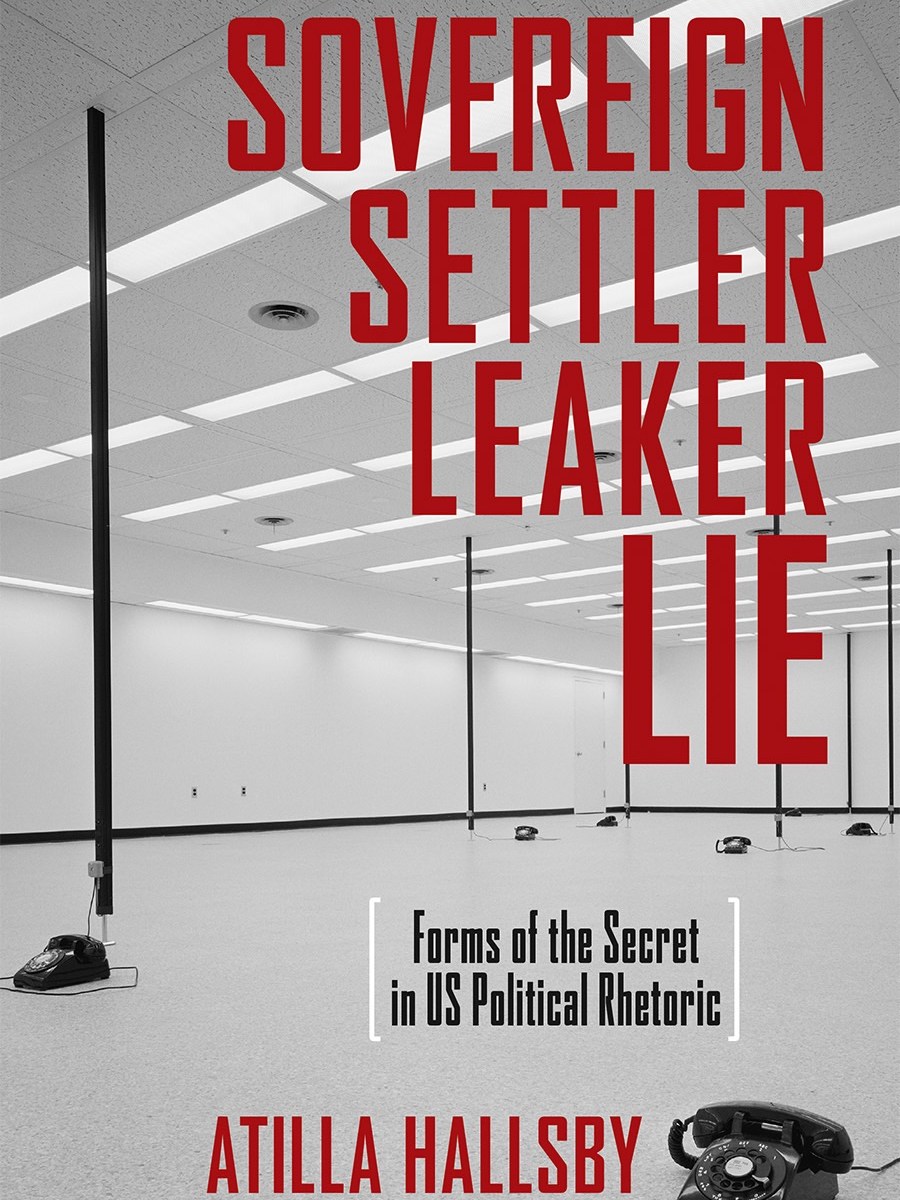
“Sovereign, Settler, Leaker, Lie”: New Recordings, Podcasts, Press, and Upcoming Events

I’m happy to share that in Spring 2026, Sovereign, Settler, Leaker, Lie: Forms of the Secret in US Political Rhetoric has received a lot of attention! Below, you’ll find a brief summary of those events with links to video recordings, podcasts, press releases, and upcoming book events!

The Big Rhetorical Podcast

I was delighted to Dr. Chase Woods of Texas A&M University, Commerce about the book in April! The interview is featured on Spotify and Apple Podcasts for those who want to listen in. Our chat covers a lot, and provides the most accessible introduction to the book’s arguments about how secrecy and surveillance are structuring, rhetorical features of the present political polycrisis.

Listen in here!

College of Liberal Arts Newsletter

Most recently, I was interviewed by Bayleigh Bergner of the University of Minnesota’s College of Liberal Arts for a short feature on Sovereign, Settler, Leaker, Lie. I answer questions about the book’s argument, the future of secrecy, the origins of the book, and what’s next!

Check out the interview here!

Chapter-by-Chapter Recordings

As part of a Spring 2026 undergraduate course (4xxx-level, “The Rhetoric of Secrecy and Surveillance”) I assembled synoptic recorded lectures to correspond with five of the chapters (“The secret in/of discourse, the scandal, the dogwhistle, the leaker, and the detective). The full suite of recorded lectures for “The Rhetoric of Secrecy and Surveillance” is also available for viewing and/or use in advanced undergraduate courses.

The chapter-by-chapter lectures can be accessed here.

You can also access the full Spring 2026 class here.

The Page 99 Test

Sovereign, Settler, Leaker, Lie was also featured on “The Page 99 Test” blog, which offers brief, synoptic overviews of recently released books based on what appears on … you guessed it, page 99.

You can read the entry (and about what appears on that page) here.

Book Release Event

On Wed, Mar 18, 2026, the Department of Race, Indigeneity, Disability, Gender, and Sexuality Studies (RIDGS) at the University of Minnesota hosted a release party for Sovereign, Settler, Leaker Lie. The event was hosted by Kyra Bowar (Communication Studies at the University of Minnesota) and featured superlative responses from Dr. Ira Allen (University of Northern Arizona) and Dr. Palita Chunsaengchan (University of Minnesota, Twin Cities).

You can access a recording of the book event from 3/18 HERE.

More Book-Related Events

In late May, I will be presenting at the biennial Rhetoric Society of America conference in Portland, OR, where there will be two panels featuring Sovereign, Settler, Leaker, Lie. Please mark your calendars if you’re going to be at the conference!

  • On Friday, May 22 (4:15-5:30pm), I will be presenting on “The Nothing that is Something: Conspiracy, Secrecy, and Audience in Our Inverted World” with Drs. Paul Johnson (University of Pittsburgh), Joseph Packer (Central Michigan University), Calum Matheson (University of Pittsburgh), and Johanna Hartelius (University of Texas at Austin). The panel will feature responses to both Sovereign, Settler, Leaker, Lie and to Joseph Packer and Ethan Stoneman’s Cypher Culture: Conspiracy, Pronoia, and the Messages that Were Not There (Louisiana State University Press).
  • On Saturday, May 23 (8:00-10:45am), I will present on the dual-session book panel “New Books in Rhetorical History/History of Rhetoric,” which is sponsored by the American Society for the History of Rhetoric (ASHR). This dual book panel will feature a number of recently published books and their authors, including Derek Handley (Struggle for the City, Penn State University Press) , José Izaguirre (Becoming La Raza, Penn State University Press), Michael Steudeman (Absence of National Feeling, University Press of Mississippi), Emily Winderman (Back-Alley Abortion, Johns Hopkins University Press), Noor Ghazal Aswad (Searching for Solidarity, Ohio State University Press), Mary Triece (Radical Advocate, University of Alabama Press), and Sara VenderHaagen (Community and Critique, University of South Carolina Press).

About Sovereign, Settler, Leaker, Lie

If you are interested in purchasing a copy, please use the code HALLSBY at www.ohiostatepress.org to receive 30% off of the paperback version. This book will be freely available in an open access edition thanks to TOME (Toward an Open Monograph Ecosystem)—a collaboration of the Association of American Universities, the Association of University Presses, and the Association of Research Libraries—and the generous support of the University of Minnesota Libraries. Learn more at the TOME website, available at openmonographs.org. An open access copy of the monograph is also currently available to view at The Ohio State University’s Knowledge Bank repository.

Research Presentation for the Institute for Advanced Studies: “The Settler’s Secret: Analepsis, Paralipsis, Prolepsis”

On February 27th, 2024, I delivered a research presentation as part of a spring semester fellowship with the Institute for Advanced Studies at the University of Minnesota, Twin Cities Campus. The presentation draws on a recently completed chapter of my manuscript, which is likewise titled “The Settler’s Secret.”

I had previously presented a longer version of this presentation for the Department of Communication Arts at the University of Wisconsin Madison on February 15, 2024, as part of their Rhetoric, Politics, and Culture Colloquium Series. My thanks go out to Drs. Allison Prasch, Rob Asen, Jennell Johnson, Rob Howard, Mary McCoy, and the graduate students of Communication Arts at UW Madison for extending this invitation and opportunity to share research.

Abstract/Synopsis: The presentation examines narrative tropes that characterize the psyche and worldview of the “settler subject”—the Western protagonist across stories of neocolonial conquest. Specifically, this settler subject adopts the role of detective, imagining themselves as a detector of atrocities while disavowing complicity in the systems of violence they discover. Rather than drawing on the detective’s substantive traits, this egoic position is triangulated by narrative tropes: analepsis (past), paralipsis (present), and prolepsis (future). Rhetorically, the prefixes ana-, para-, and pro- evoke forms of self-effacement that place the settler “in the middle of things,” as the main character in a story that is not about them. Analepsis establishes the settler’s narrative past by rewriting history, paralipsis enables the settler to acknowledge but disidentify with neocolonial acts, and prolepsis forecasts apocalyptic outcomes that perversely reinforce the settler’s need for continuous armament. Each trope also aligns with a psychoanalytic register – the Symbolic, Imaginary, and Real, respectively – which manage the absent center of settler subjectivity. The discussion of each trope is paired with a unique collection of texts to demonstrate the dispersion of these subject-constituting tropes across coverage of contemporary, high-tech war.

DRPC Privacy Week Presentation: “We Live In Public”

On January 22, 2024, the Digital Rhetoric and Privacy Collective hosted an online session titled “Teaching About Privacy in an Age of Generative AI“ with Drs. Calvin Pollak of the University of Washington (who presented “Navigating Publicity and Privacy: Genre-Based Technical Communication Pedagogy With, For, and Against ChatGPT”) and Reed Hepler, a Digital Initiatives Librarian and Archivist at College of Southern Idaho (who presented “Deliberately Safeguarding Privacy and Confidentiality in the Era of Generative AI”) and myself. The title of my presentation was “We Live in Public: Teaching Publicity, Privacy, and Secrecy.” Links to both the DRPC and a video of the presentation(s) can be found below.

“Secrecy, Surveillance, and Settler Colonialism”: A Rhetoric Society of America Workshop (May 25-27, 2023)

Hi folks,

On alternating years, the Rhetoric Society of America hosts seminars and workshops for faculty and graduate students. This upcoming year, Dr. Michael Lechuga of the University of New Mexico and I will be leading a two-day workshop from May 25-27. The sessions will be held at Pennsylvania State University in College Park, with limited remote access. I’m writing now because the deadline to apply for this (and all other) sessions is approaching on October 15, 2022. Please follow this link to apply! As that site notes, applicants will be notified of your acceptance into a particular session (or multiple sessions) by November 15, 2022.

Below, you’ll find a description of our session on “Secrecy, Surveillance, and Settler Colonialism,” (also available via the hyperlink). I hope you’ll check it out!

Best wishes,

Atilla

Secrecy, Surveillance, and Settler Colonialism

Our topical focus is the rhetoric of settler colonialism with emphasis on erasure, disinformation, and conspiratorial reasoning, as exemplified by the dehumanization of migrants at the Mexico/US border, the “Stop the Steal” January 6, 2021, white supremacist insurrection, and the infiltration of colonialist themes in popular science fiction narratives. We invite participants to think through the connections between events like the January 6 insurrection, gun violence, and pandemic politics as explained through the lens of settler colonialism. Our workshop focuses on how the critical frameworks of psychoanalysis and assemblage theory are instrumental for rhetoricians’ understanding of the lasting legacy of settler colonialism in the United States. Together, we (Lechuga and Hallsby) represent expertise in both rhetorical criticism, assemblage/affect theory (Lechuga), and psychoanalysis (Hallsby). We offer attendees an affect-driven framework for emerging rhetorical scholars, designed with the specific goal of attending to Settler Colonialism’s ideological, material, and unconscious formations. 

Participants should expect to complete some assigned readings ahead of time and to submit a (2pp) statement about what they are already researching. During the session, we aim to discuss how the frameworks introduced during the workshop might be enlisted to revise or approach these topics. Position papers should also include a statement of participants’ goals for the workshop (e.g., creating a syllabus, conference paper, journal submission/revision, white papers/public facing, advocacy). The workshop will be divided between lecture and break-out groups/discussions. During break-out discussions, participants will also have the option to work individually or in a group (i.e., they may choose to be either self-directed or collaborate with others working on similar projects.)

Whereas Rhetorical Studies conventionally emphasizes the rhetorical situation/ecology as a general contextual framework for persuasion, representation, and power, we would advance arguments for understanding rhetoric’s persisting habitus as a Settler Situation, a set of recurring/repeating historical contexts appealing to topoi of jingoistic conquest, extraction economies, and racial purity. We offer the following framing questions: (1) How do we read and measure settler-colonial narratives/events? What is the archive of settler colonialism? If the archive is secret, what tools or techniques do rhetoricians have available to read it? (2) How does the Settler Situation redefine the conventional boundaries of the rhetorical text? What aspects of rhetoric’s conventional focus on public address and representation are retained by this framework and which are transformed by it? (3) How do (psychoanalytic/assemblage-based) theories of affect account for the combined psychological and material injury created by contemporary nationalist discourses? (4) How do present-but-unarticulated or unacknowledged affects produce recurring patterns of historical trauma? What can rhetorical studies contribute to the understanding of these historical patterns?