
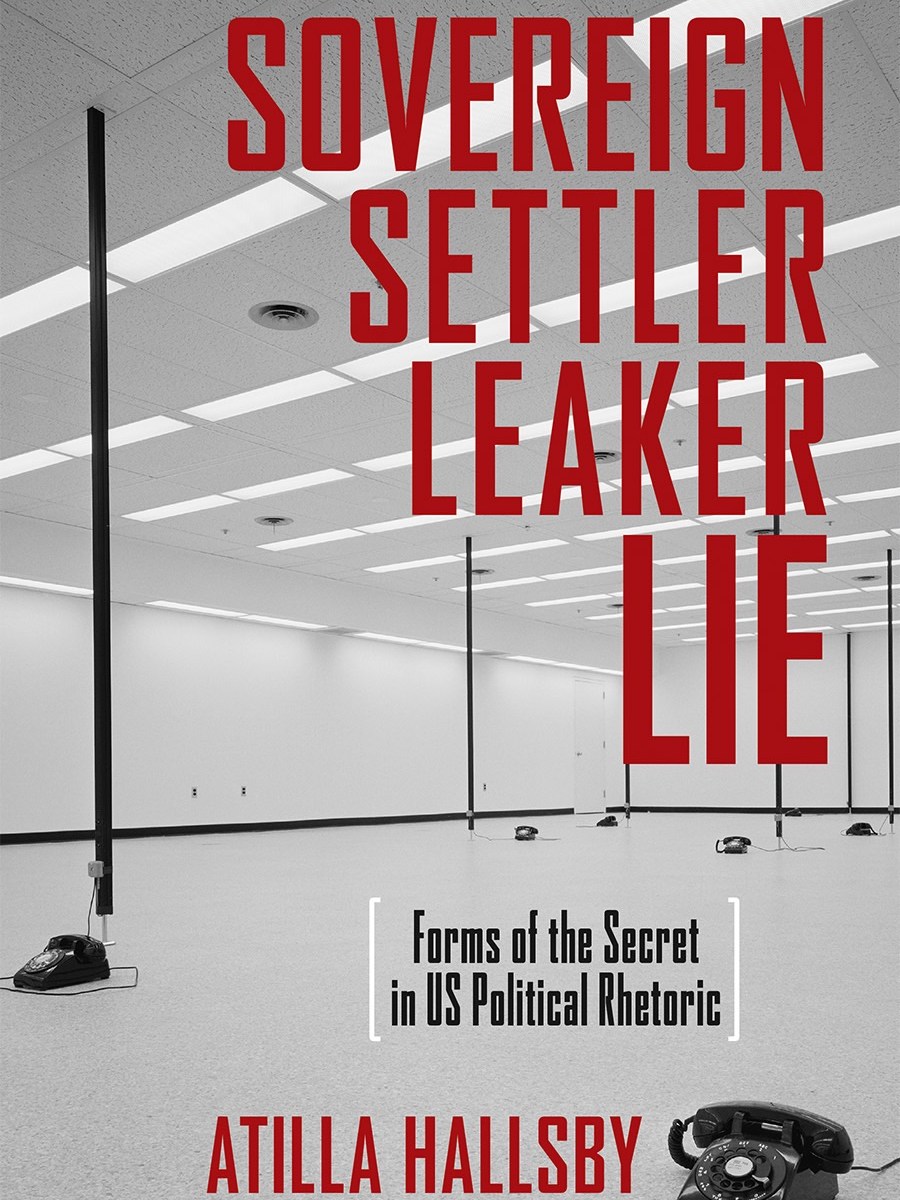
I’m happy to share that in Spring 2026, Sovereign, Settler, Leaker, Lie: Forms of the Secret in US Political Rhetoric has received a lot of attention! Below, you’ll find a brief summary of those events with links to video recordings, podcasts, press releases, and upcoming book events!
The Big Rhetorical Podcast
I was delighted to Dr. Chase Woods of Texas A&M University, Commerce about the book in April! The interview is featured on Spotify and Apple Podcasts for those who want to listen in. Our chat covers a lot, and provides the most accessible introduction to the book’s arguments about how secrecy and surveillance are structuring, rhetorical features of the present political polycrisis.
College of Liberal Arts Newsletter
Most recently, I was interviewed by Bayleigh Bergner of the University of Minnesota’s College of Liberal Arts for a short feature on Sovereign, Settler, Leaker, Lie. I answer questions about the book’s argument, the future of secrecy, the origins of the book, and what’s next!
Chapter-by-Chapter Recordings
As part of a Spring 2026 undergraduate course (4xxx-level, “The Rhetoric of Secrecy and Surveillance”) I assembled synoptic recorded lectures to correspond with five of the chapters (“The secret in/of discourse, the scandal, the dogwhistle, the leaker, and the detective). The full suite of recorded lectures for “The Rhetoric of Secrecy and Surveillance” is also available for viewing and/or use in advanced undergraduate courses.
The chapter-by-chapter lectures can be accessed here.
You can also access the full Spring 2026 class here.
The Page 99 Test
Sovereign, Settler, Leaker, Lie was also featured on “The Page 99 Test” blog, which offers brief, synoptic overviews of recently released books based on what appears on … you guessed it, page 99.
You can read the entry (and about what appears on that page) here.
Book Release Event
On Wed, Mar 18, 2026, the Department of Race, Indigeneity, Disability, Gender, and Sexuality Studies (RIDGS) at the University of Minnesota hosted a release party for Sovereign, Settler, Leaker Lie. The event was hosted by Kyra Bowar (Communication Studies at the University of Minnesota) and featured superlative responses from Dr. Ira Allen (University of Northern Arizona) and Dr. Palita Chunsaengchan (University of Minnesota, Twin Cities).
You can access a recording of the book event from 3/18 HERE.
More Book-Related Events
In late May, I will be presenting at the biennial Rhetoric Society of America conference in Portland, OR, where there will be two panels featuring Sovereign, Settler, Leaker, Lie. Please mark your calendars if you’re going to be at the conference!
- On Friday, May 22 (4:15-5:30pm), I will be presenting on “The Nothing that is Something: Conspiracy, Secrecy, and Audience in Our Inverted World” with Drs. Paul Johnson (University of Pittsburgh), Joseph Packer (Central Michigan University), Calum Matheson (University of Pittsburgh), and Johanna Hartelius (University of Texas at Austin). The panel will feature responses to both Sovereign, Settler, Leaker, Lie and to Joseph Packer and Ethan Stoneman’s Cypher Culture: Conspiracy, Pronoia, and the Messages that Were Not There (Louisiana State University Press).
- On Saturday, May 23 (8:00-10:45am), I will present on the dual-session book panel “New Books in Rhetorical History/History of Rhetoric,” which is sponsored by the American Society for the History of Rhetoric (ASHR). This dual book panel will feature a number of recently published books and their authors, including Derek Handley (Struggle for the City, Penn State University Press) , José Izaguirre (Becoming La Raza, Penn State University Press), Michael Steudeman (Absence of National Feeling, University Press of Mississippi), Emily Winderman (Back-Alley Abortion, Johns Hopkins University Press), Noor Ghazal Aswad (Searching for Solidarity, Ohio State University Press), Mary Triece (Radical Advocate, University of Alabama Press), and Sara VenderHaagen (Community and Critique, University of South Carolina Press).
About Sovereign, Settler, Leaker, Lie
If you are interested in purchasing a copy, please use the code HALLSBY at www.ohiostatepress.org to receive 30% off of the paperback version. This book will be freely available in an open access edition thanks to TOME (Toward an Open Monograph Ecosystem)—a collaboration of the Association of American Universities, the Association of University Presses, and the Association of Research Libraries—and the generous support of the University of Minnesota Libraries. Learn more at the TOME website, available at openmonographs.org. An open access copy of the monograph is also currently available to view at The Ohio State University’s Knowledge Bank repository.

