
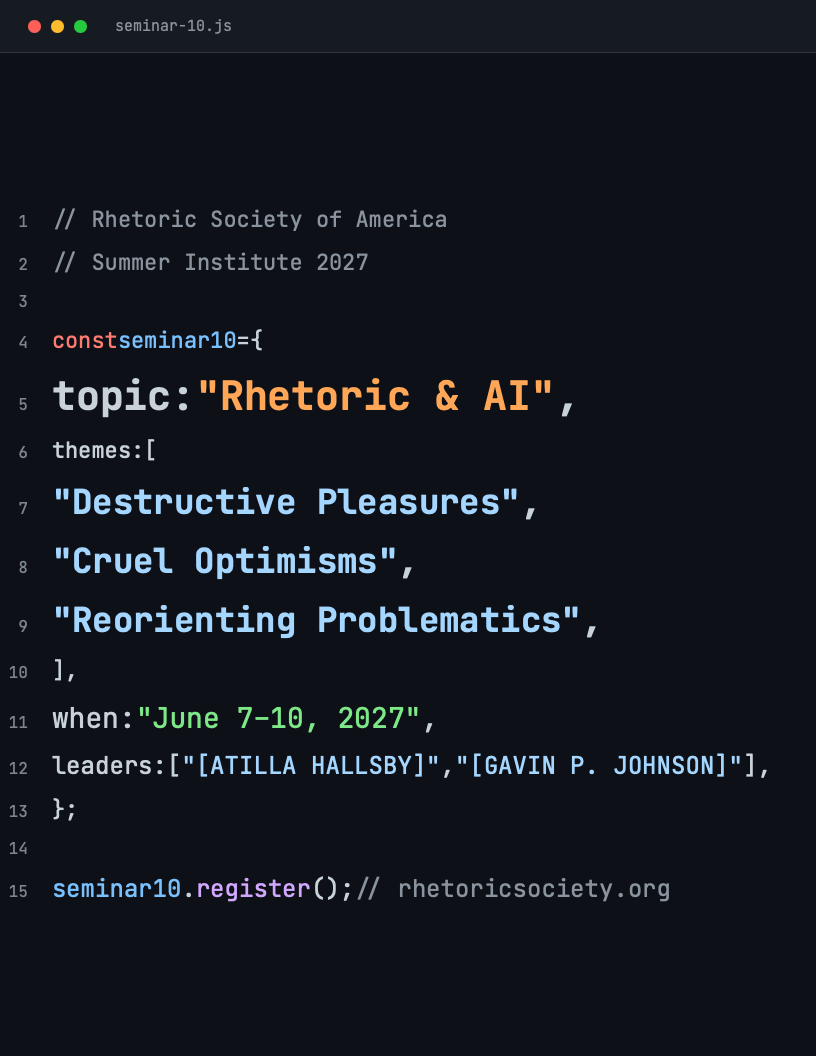
From June 7 – 10, 2027, I’ll be co-leading an RSA seminar with Gavin Johnson of Texas Christian University about critical and rhetorical approaches to artificial intelligence! The seminar will be equal parts reading/discussion, writing workshop, and resource-sharing. If you are working on critical and humanistic projects related to artificial intelligence, come join us for an awesome week in Louisville, KY! The session description appears below.
- Sign up for the session here.
- You can find my FA26 graduate syllabus on Secrecy, Surveillance, and AI here.
- You can find my continuously updated AI resource document here.
Recent Publications by the Session Leaders:
- Hallsby, “A Copious Void: Rhetoric as Artificial Intelligence 1.0” (2024)
- Hallsby and Faltesek, “Reconstructing Kairos and Chronos across Trump’s Twitter/X Corpus” (2025)
- Hallsby, Sovereign, Settler, Leaker Lie: Forms of the Secret in US Political Rhetoric (2026)
- Hallsby, “Operation Metro Surge and the Rhetoric of State-Sponsored Violence” (2026)
- Johnson and Smith, “Against the Reading Response: Digital Meaning Making Through Social Annotation and Authentic Content Genres” (2025)
- Johnson, “Discomfort, Kinky Empiricists, and the Work of Queering Research Methods” in Methodological Matters (2026)
- Woods and Johnson, “(Re)Designing Privacy Literacy in the Age of Generative AI” (2024)
- And more on the way!
About the Seminar
Why do people opt into technologies they recognize as dangerous? How can we simultaneously name AI’s destruction—environmental damage, hypersurveillance, data extraction, epistemic degradation—and still justify the pleasures of using it? Existing scholarship in rhetoric and AI has converged on a set of commonplaces about disruption, harm, and utility, but these accounts remain reactive, stranded in a synchronic present too thin to support durable critique. This seminar argues that understanding AI’s affective-rhetorical realities requires a vocabulary for destruction-as-pleasure that doesn’t rely on mystification—the assumption that people acquiesce to harmful conditions only because they’ve been deceived. Drawing on the death drive (Edelman) and cruel optimism (Berlant) as well as necropolitics (Mbembe) and rhetorical critiques of AI (Hallsby; Wang), we develop realist, sympathetic, and strategic accounts of AI’s proliferation, treating self-destructive attachment as intelligible rather than simply false consciousness.
These accounts anchor five interlocking problematics: the death drive––pleasure principle continuum structuring AI adoption; AI as an “undead” technology that revives older logics of racialized and extractive violence; the kakoethos, or pathological (bad) character, of the AI founder class; a hypercapitalist antihumanism that renders human judgment and labor increasingly worthless; and a shift in surveillance from panoptic observation to anticipatory foreclosure. Together, these threads work toward a shared rhetorical vocabulary capable of naming destruction and pleasure at once while being durable enough to outlast the boosterism/doomerism cycle that continually resets public debate.
Through participant-driven discussion, short writing tasks, and collaborative exchange, this seminar invites scholars in rhetoric, communication, and writing studies to build new critical and pedagogical responses to AI’s affective hold.
Aims
Across five interlocking problematics, this seminar works toward a shared rhetorical vocabulary for AI critique. Our aim is to articulate with participants a way of naming destruction and pleasure together without collapsing either into false consciousness, but durable enough to outlast the next reset of the boomerism/doomerism cycle.
By the end of the seminar, participats will.
- Apply rhetorical, affective, and ideological criticism to account for AI’s destruction-as-pleasure;
- Analyze the asymmetrical harms AI enacts on raced, gendered, disabled, and geographically situated communities, and explain how these harms are naturalized through surveillance, hypercapitalism, and antihumanist logics of dispossession;
- Situate AI developers’ ideological commitments––and the affective habitus of kakoethos that sustains them––within the broader systems of extraction and value that AI’s proliferation depends on; and
- Develop strategies rhetorical responses capable of holding critique open against the boosterism/doomerism cycle that otherwise forecloses sustained, rhetorical imagining.
Grounding/Reorientations
Why do people opt into technologies they recognize as dangerous? How can we simultaneously name AI destruction––environmental damage, hypersurveillance, data extraction, epistemic degradation––and still justify the pleasures of using it? Scholarship in rhetoric and AI has so far lacked the vocabulary to account for this tension, converging instead on several commonplaces: that AI’s rhetoricity emerges from its disruptive operations in/of rhetoric (Wang “Post-rhetoric”; Graham and Majdik; Hallsby); that AI enacts asymmetrical material harm on communities and infrastructures (Edwards; Crawford); that AI creates wicked problems for education, especially in writing and communication courses (Sano Franchini et al.; Davis et al.); and that, notwithstanding these harms, AI offers utility for research and teaching and AI literacy is an essential technology for future success (MacArthur; Ranade, Saravia, and Johri). Each commonplace leads to the same rhetorical problem: it seems impossible to say anything about AI that is not purely reactive or stranded in a synchronic moment too thin to support durable critique.
This RSA seminar argues that accounting for the affective-rhetorical realities of AI requires a way to articulate and explain destruction-as-pleasure without relying on mystification, which we understand as the assumption that people acquiesce to conditions against their own interest only because they have been deceived, distracted, or ideological captured. We turn to concepts like the death drive (Edelman) and cruel optimism (Berlant) as frameworks for understanding self-destructive attachments as intelligible, even rational, and an affective structure the rhetorical studies must reckon with directly if our critiques are to effectively reorient AI discourse and its material impacts.
Three accounts follow this reorientation.
- A realist account attends to how AI plugs into existing systems of value and extraction rather than treating it as a genuinely novel technological frontier. AI, therefore, is best understood not as disembodied intelligence but as a planetary infrastructure that does not live outside of imperialism, militarism, and white supremacy as a novel force but, rather, mimics and extends their organizing logics (Katz; Crawford; Edwards); its power lies in how it reactivates older logics of disposition/dispossession.
- A sympathetic account attends to the centrality of self-destructive pleasure for developers and subscribers alike, rather than assuming that adoption occurs only through rhetorical deception or coercion. AI developers marshal a substantial repertoire of “ugly feelings” such as paranoia, envy, and anxiety as the ‘“normal” experience of having been “plugged in” to a digital sphere that claims to think on the user’s behalf. While scholars like Sianne Ngai locate the ugly feelings of modernism in the bourgeois subject’s felt powerlessness, the ugly feelings of AI emerge from participation in, felt inertia toward, and cyclical in/validation of the self as social-emotional regression branded as inevitable transformative progress.
- A strategic account attends to the disproportionate harms of AI through affective registers like shame, parody, and satire to counter the boosterism/doomerism cycle that currently structures public discourse, a cycle that forecloses sustained critique by continually resetting the terms of debate. Understanding affect as a circulating, public economy (Ahmed; Wang “The Banality”), brings into view attempts to navigate harm through satire and parody (Morgan), which argues holds critique open in the face of progressive narratives of political neutrality and techno-utopian fantasies.
Interlocking Problematics
To develop and test these reorienting accounts, this seminar addresses five interlocking subject areas or problematics.
Death Drive––Pleasure Principle
The first problematic concerns the incentive structures of neoliberal capitalism alongside the embodied urges that make LLMs and other AI technologies feel pleasurable because it reduces discomfort or tension. With respect to the death drive, AI developers and their philosophical champions (e.g., longtermists, effective altruists) frame AI maximalism as an “end” to the status quo, transforming labor, education, political participation, and health care. Beyond the literal harm of data-center expansion, mineral extraction, and community health impact, the death drive names a fetishistic attachment to ending the anarchronistic present to realize a utopic afterlife facilitated by chatbots and autonomous agents ruled over by a techno-oligarchy (Gebru and Torres; Taskale). The pleasure principle, meanwhile, is experienced as relief from mundane labor while doing nothing to quell the global demands for labor, resources, and energy; AI, in fact, intensifies these demands enforcing pain in the Global South as much as it provides relief for the so-called “first world” (Mejias and Couldry). The twin processes of hurtling toward a utopic/apocalyptic end and the deferred (and deceptive) promise of pleasurable relief form two theoretical touchstones that inform our empathic approach to AI, seeking to understand the motives and the affective experiences of those who are closest to it.
AI as an Undead Technology
AI is “undead” in two senses. On the one hand, following Tamara Kneese, AI literally resurrects––it creates holographic simulacra of the dead and revives the voice and tone of living authors via agentic simulations. On the other, following the theoretical trajectory of Eric King Watts and Ruha Benjamin, we connect the present age of autonomous robots and disembodied labor to the ongoing harms of chattel slavery and mass incarceration: not a rupture or departure from the past but a continuation of different forms of founding violence. The so-called “dream” of an artificial agent completing mundane, time-consuming tasks hearkens to earlier reductions of human action to inhuman motion, enabling beneficiaries to act as if there is no physical, emotional, environmental, or economic cost. AI, in other words, is the most contemporary manifestation of the undead zombie: a body devoid of humanity whose social and rhetorical function is to support capitalist consumption, cultivate apathy toward a laboring caste, and produce goods without claim to the underlying intellectual property. Perversely, AI’s documented effects (cognitive offloading, reduction of stress tolerance) turn addicted users into the very unthinking, unmoving, all-consuming automata that AI is meant to embody.
AI Founders and Kakoethos
Emphasizing the pleasurable affects associated with AI developers, we foreground the utility of kakoethos as a descriptive term of art for the extractive impulses and prurient indulgences of the AI founder class. Kakoethos may be defined as “pathologically bad character,” in the sense that it is fixated on downplaying the humanity of users and dissenters, inflicting punishment as a motivational strategy, and seeking emotional release in the form of mastery over marketplace competitors. Rather than a theory of superstructural interest, our emphasis is on the limited affective habitus cultivated by the ultra-wealthy seeking to enforce the inevitability of artificial intelligence as inextricable from quotidian life (Daub). Supported by philosophical commonplaces including “the sovereign individual,” “superintelligence,” and “the dark enlightenment,” the affective worlds of this superstratum of the 1% rely upon a continuous justification of exceptionality and elitism on the part of the plutocrat-founder caste.
Hypercapitalist Antihumanism
Where kakoethos describes the affective habitus of the founder class, hypercapitalist antihumanism names the logic that habitus serves. Following Mark Fisher’s account of capitalist realism––the foreclosure of any horizon beyond capital in which it is preferable to imagine the end of the world rather than the end of capitalism––AI marks a phase in which even human labor and cognition becomes redundant and actually slows economic accumulation. This is antihumanism in an active sense, not the philosophical decentering of the human subject but the practical devaluation of human worth when value cannot be extracted (Daniel). Achille Mbembe’s concept of necropolitics offers clarification to AI’s task of sorting populations into those whose lives are optimized, personalized, and rendered legible for capital and those whose exposure to harm is the precondition of that optimization. In naming hypercapitalist antihumanism as both philosophy and infrastructure, we highlight how the more AI founders and their rhetorics promise to expand human capacity, the more it forecloses the conditions under which human life, labor, and judgement retain value at all.
Surveillance
AI’s proliferation depends on a shift in the modality of surveillance from purely panoptic toward anticipatory. Shoshana Zuboff’s account of surveillance capitalism describes a mode of power less interested in watching and oriented toward shaping or even foreclosing possibilities before they occur. The predictive apparatus relies on algorithmic bias to reproduce and naturalize racialized, gendered, and ableist harm under the alibi of neutral computation (Noble). Building on rhetorical approaches to AI and other surveillant technologies (Graham and Majdik; Banville and Johnson), we argue that surveillance is laundered as convenience, personalization, or care, which are the same pleasures that, per our opening problematic, make its harms bearable or even desirable. Surveillance, thus, loops back into the death drive––pleasure principle continuum wherein to be watched, predicted, and optimized is presented as a form of being and being known, and the resulting pleasure is rhetorically inseparable from the harm it conceals.

